

Cepheus
The King
General Information
- Abbreviation: Cep
- Area: about 588 square degrees
- Area rank: 27 among the 88 modern constellations
Introduction
Cepheus, also known as the King, is one of the 88 constellations officially recognized by the International Astronomical Union (IAU). Located in the northern sky, it is named after King Cepheus from Greek mythology.
Covering approximately 588 square degrees, Cepheus is the 27th-largest constellation in the night sky. It lies close to the north celestial pole and is best observed around October.
Overview
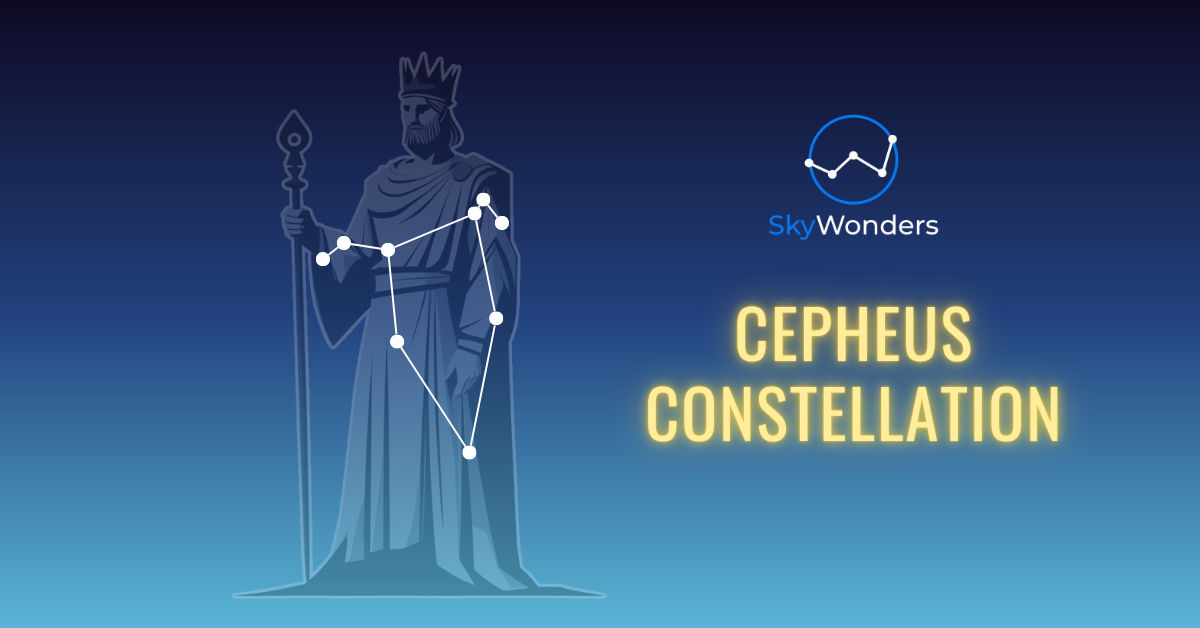
Cepheus is located near the north celestial pole, making it a circumpolar constellation for many observers at mid-northern latitudes. Its most recognizable stars form a pattern resembling a house with a pointed roof, traditionally associated with the figure of a king.
The constellation contains several notable stars, including Alderamin, Delta Cephei, Mu Cephei, and Alfirk. It is also home to the Iris Nebula and lies near the prominent Fireworks Galaxy.
Shape
Cepheus is traditionally depicted as a king seated on a throne. Its main stars form a distinctive pattern resembling a house with a pointed roof. Five prominent stars outline this basic shape, making the constellation easier to identify among its neighboring star patterns.
Notable Stars
Alderamin
Alderamin (Alpha Cephei) is the brightest star in Cepheus, with an apparent magnitude of approximately 2.5. Located about 49 light-years from Earth, it is a white main-sequence star that rotates rapidly. Due to Earth's axial precession, Alderamin is expected to become the North Star around the year 7500.
Delta Cephei
Delta Cephei is a yellow supergiant located approximately 890 light-years from Earth. It is the prototype of the classical Cepheid variable stars, whose brightness changes regularly as they expand and contract. The relationship between their pulsation periods and intrinsic luminosities makes Cepheids important tools for measuring astronomical distances.
Mu Cephei
Mu Cephei, commonly known as Herschel's Garnet Star, is a red supergiant located approximately 2,800 light-years from Earth. Its deep reddish color makes it one of the most distinctive stars in Cepheus. It is also a semiregular variable star whose brightness fluctuates over time.
How to Observe
Cepheus is best observed from August to November in the Northern Hemisphere, although it remains visible throughout the year from many northern locations. Find Polaris using the Big Dipper's Pointer Stars or Cassiopeia's W shape. Cepheus lies between Cassiopeia and Draco, close to Polaris.
Look for its distinctive house-shaped pattern, with Alderamin marking one of its brightest corners. Binoculars can help reveal its fainter stars, while telescopes are useful for observing the Garnet Star (Mu Cephei), a striking red supergiant.