

Sky Wonders logoSky Wonders logoSky Wonders
  • Astronomical Events
  • Constellations
  • Explore
Sky Wonders logoSky Wonders logoSky Wonders

Explore the Wonders Above.

Contact

  • skywonders.net
  • skywondersnet@gmail.com

Follow Us

Grus

The Crane

General Information

  • Abbreviation: Gru
  • Area: about 366 square degrees
  • Area rank: 45 among the 88 modern constellations
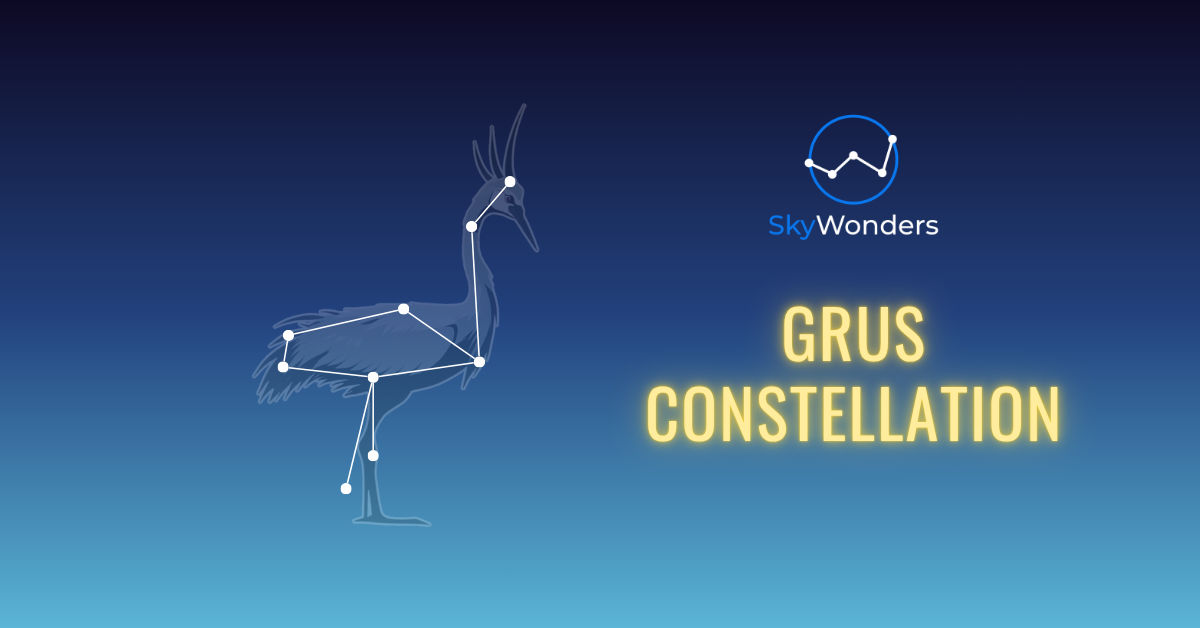
Grus constellation
Grus constellation

Table of Contents

  1. Introduction
  2. Overview
  3. Shape
  4. Notable Stars
  5. Alnair
  6. Tiaki
  7. How to Observe
  8. Deep-Sky Objects
  9. NGC 7213
  10. NGC 7424
  11. IC 1459
  12. NGC 7582
  13. NGC 7552
  14. NGC 7232
  15. Mythology
  16. History
  17. Conclusion

Introduction

Grus, also known as the Crane, is a constellation in the southern sky, representing a crane with a long neck and outstretched wings. Its name comes from the Latin word for “crane.”

The constellation is best known for Alnair, its brightest blue-white star, and Tiaki, an orange-red giant that creates a striking color contrast. Grus also contains several notable galaxies, including the Grus Quartet and the spiral galaxy NGC 7424.

Overview

Grus lies in the southern sky, near Piscis Austrinus. Its neighboring constellations are Piscis Austrinus, Microscopium, Indus, Tucana, Phoenix, and Sculptor.

The constellation is best observed from August to December, particularly between September and November. It reaches its highest position in the evening sky around October.

Grus belongs to a group of southern constellations commonly associated with birds, alongside Pavo, Phoenix, and Tucana. Together, these constellations form a distinctive collection of bird figures on the celestial map.

Shape

Grus is traditionally depicted as a crane standing with its long neck extended and its wings spread. Its brighter stars form a pattern resembling an inverted Y, suggesting the bird’s body, neck, and wings.

Alnair marks the lower body, while Tiaki and Aldhanab contribute to the prominent stars around the body and neck. The contrast between Alnair’s blue-white light and Tiaki’s orange-red color makes the constellation particularly distinctive.

Notable Stars

Alnair

Alnair (Alpha Gruis) is the brightest star in Grus, with an apparent magnitude of approximately 1.7. Located about 101 light-years from Earth, it is a hot blue-white subgiant with a surface temperature exceeding 13,000 K. Its name comes from Arabic and means "the Bright One."

Tiaki

Tiaki (Beta Gruis) is a red giant star located approximately 177 light-years from Earth. It is an irregular variable star whose brightness fluctuates between approximately magnitudes 2.0 and 2.3. Its deep reddish appearance contrasts noticeably with the blue-white light of Alnair.

How to Observe

Grus is best observed from August to November in the Southern Hemisphere. First locate Fomalhaut in Piscis Austrinus, then look southward toward a prominent pair of stars, Alnair and Al Dhanab, which help outline the Crane's body and tail.

Its relatively bright stars make Grus easier to identify than many nearby southern constellations. Binoculars can help explore its star fields and locate the globular cluster NGC 7213's surrounding region.

Deep-Sky Objects

NGC 7213

NGC 7213 is a lenticular galaxy with an active central region powered by a supermassive black hole. Its relatively nearby location makes it useful for studying the relationship between galactic nuclei and their host galaxies.

Other Constellations

  • Crux constellation

    Crux

    The Southern Cross

  • Cygnus constellation

    Cygnus

    The Swan

  • Scorpius constellation

    Scorpius

    The Scorpion

  • Lyra constellation

    Lyra

    The Lyre

  • Ursa Major constellation

    Ursa Major

    The Great Bear

NGC 7424

NGC 7424 is a barred spiral galaxy with loosely wound arms extending from its central bar. Its extended structure and star-forming regions provide an interesting example of a relatively open spiral galaxy.

IC 1459

IC 1459 is a giant elliptical galaxy with a bright central region and an unusually complex stellar structure. Its active nucleus and central supermassive black hole make it an important object for studying massive galaxies.

NGC 7582

NGC 7582 is a barred spiral galaxy with an active nucleus and prominent dust lanes crossing its central region. It belongs to the Grus Quartet, a group of interacting galaxies that provides insight into galactic interactions and evolution.

NGC 7552

NGC 7552 is a barred spiral galaxy known for its intense star formation concentrated in a ring around its nucleus. This central starburst region makes it a valuable object for studying how gas accumulates and forms stars in galactic centers.

NGC 7232

NGC 7232 is a spiral galaxy that forms part of a close group with NGC 7233 and other nearby galaxies. Their similar distances and apparent proximity make this system an interesting example of galaxy interactions.

Mythology

Grus does not have a widely established ancient Greek mythological story associated with it. Its crane figure primarily originated from the observation and naming of southern stars during the late 16th century.

In ancient cultures, cranes were recognized for their long necks, broad wings, and remarkable migratory journeys. This familiar bird provided a fitting image for astronomers who later represented the constellation on celestial maps.

History

Grus was introduced into European celestial mapping in the late 16th century. Its stars had previously been considered part of Piscis Austrinus, particularly the region around the southern fish’s tail.

During a Dutch expedition to the East Indies from 1595 to 1597, navigators Pieter Dirkszoon Keyser and Frederick de Houtman recorded the positions of numerous southern stars. Their observations contributed to the creation of a group of 12 new southern constellations.

The Dutch-Flemish cartographer Petrus Plancius used these observations to include Grus on a celestial globe published in 1598 with Jodocus Hondius. Later, the German astronomer Johann Bayer depicted the constellation in his star atlas Uranometria in 1603, helping establish the name Grus in European astronomy.

Some of Grus’s stars had previously been assigned to Piscis Austrinus before the new constellation was established. This historical connection helps explain why the two constellations lie close together in the modern sky.

Today, Grus is one of the 88 constellations officially recognized by the International Astronomical Union (IAU), which standardized constellation boundaries during the 20th century.

Conclusion

Grus is a southern constellation representing a crane, distinguished by the contrasting stars Alnair and Tiaki. Beyond its prominent stars, it contains notable galaxies such as the Grus Quartet and NGC 7424. Its relatively recent history also reflects an important period in the exploration and mapping of the southern sky.