

Leo
The Lion
General Information
- Abbreviation: Leo
- Area: about 947 square degrees
- Area rank: 12 among the 88 modern constellations
Introduction
Leo is a prominent zodiac constellation in the northern sky. Its name comes from the Latin word for “lion,” a symbol of strength and authority.
The constellation is best known for Regulus, its brightest star, and notable galaxies such as the Leo Triplet. In Greek mythology, Leo is commonly associated with the Nemean Lion, the first opponent Heracles faced in his Twelve Labors.
Overview
Leo lies between Cancer, Virgo, Sextans, Crater, Hydra, Leo Minor, and Ursa Major. Covering approximately 947 square degrees, it is the 12th-largest of the 88 modern constellations.
Leo lies along the ecliptic, the apparent path along which the Sun, Moon, and planets move across the sky as seen from Earth.
The constellation was recorded by Ptolemy among the 48 constellations in his work Almagest in the 2nd century. In 1922, the International Astronomical Union (IAU) officially included Leo in its list of 88 recognized constellations.
Shape
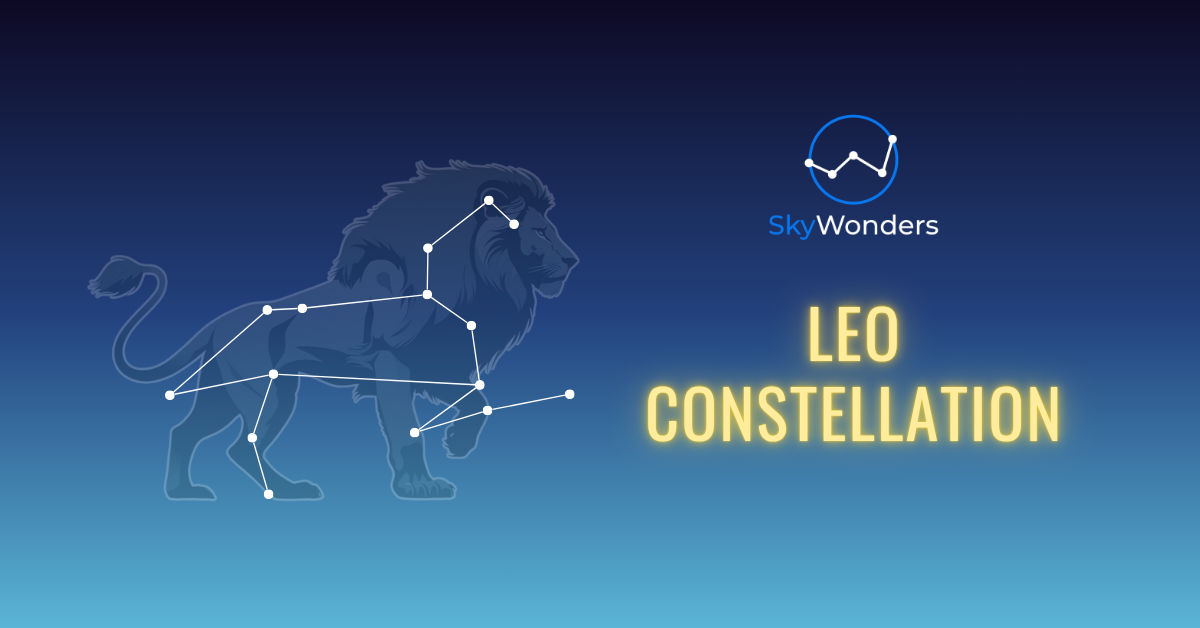
Leo is commonly imagined as a reclining lion, with its head and mane facing forward and its body and tail extending behind.
Its most recognizable feature is an asterism called The Sickle, which resembles an upside-down question mark and represents the lion's head and mane. Behind it, a roughly triangular group of stars forms the lion's hindquarters and tail.
Regulus marks the end of The Sickle's curve, while Denebola represents the lion's tail. Algieba, Adhafera, Zosma, and Chertan help complete the constellation's distinctive shape.
Notable Stars
Regulus
Regulus (Alpha Leonis) is the brightest star in Leo and one of the brightest stars in the night sky, with an apparent magnitude of approximately 1.4. Located about 79 light-years from Earth, it is a multiple-star system dominated by a rapidly rotating blue-white star. Its rotation is so fast that the primary star has an noticeably flattened shape.
Denebola
Denebola (Beta Leonis) is a white main-sequence star located approximately 36 light-years from Earth. Its name comes from Arabic and means "the Lion's Tail," reflecting its position at the rear of the constellation. Denebola is also surrounded by a debris disk containing dust produced by collisions between smaller celestial bodies.
Algieba
Algieba (Gamma Leonis) is a beautiful binary star system located approximately 130 light-years from Earth. Its two main components are giant stars with golden-yellow and orange hues, creating an attractive color contrast through a telescope. One of its components is also known to host an exoplanet.
Zosma
Zosma (Delta Leonis) is a white main-sequence star located approximately 58 light-years from Earth. With an apparent magnitude of approximately 2.6, it is one of the brightest stars in Leo and marks part of the Lion's back. Its name is derived from Greek and refers to the girdle or waist.