

Sky Wonders logoSky Wonders logoSky Wonders
  • Astronomical Events
  • Constellations
  • Explore
Sky Wonders logoSky Wonders logoSky Wonders

Explore the Wonders Above.

Contact

  • skywonders.net
  • skywondersnet@gmail.com

Follow Us

Perseus

The Hero

General Information

  • Abbreviation: Per
  • Area: about 615 square degrees
  • Area rank: 24 among the 88 modern constellations
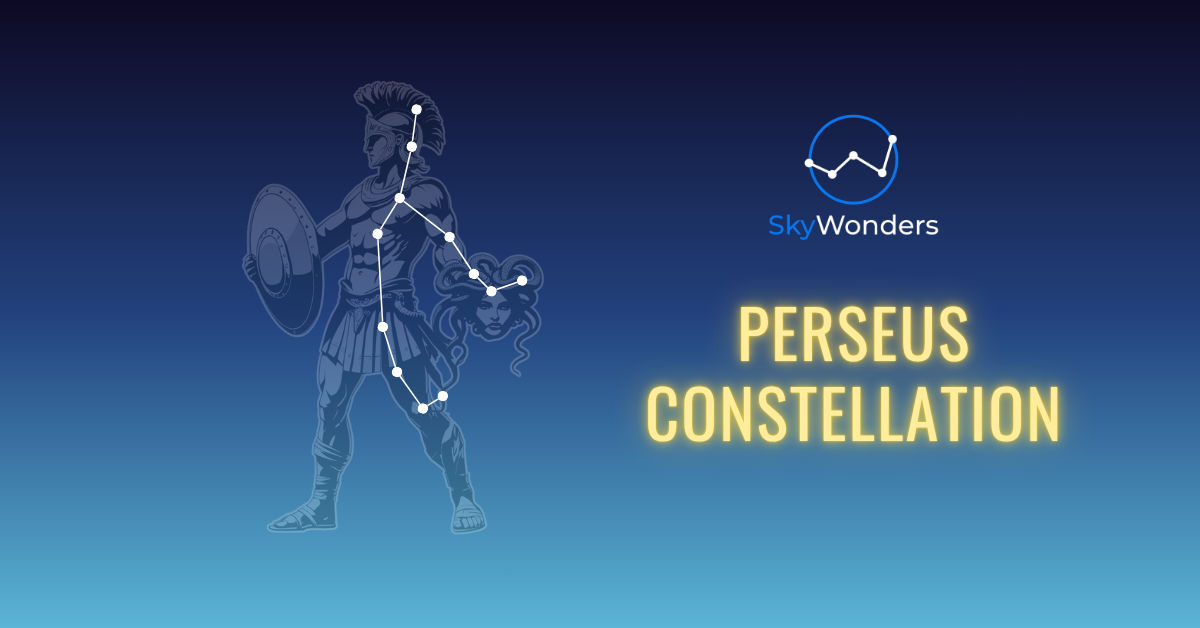
Perseus constellation

Table of Contents

  1. Introduction
  2. Overview
  3. Shape
  4. Notable Stars
  5. Mirfak
  6. Algol
  7. Atik
  8. How to Observe
  9. Deep-Sky Objects
  10. Double Cluster (NGC 869/NGC 884)
  11. Messier 34 (M34)
  12. Little Dumbbell Nebula (M76)
  13. Perseus A (NGC 1275)
  14. California Nebula (NGC 1499)
  15. NGC 1333
  16. NGC 1023
  17. Mythology
  18. Conclusion
  19. References

Introduction

Perseus is one of the 88 modern constellations, located in the Northern Hemisphere and closely associated with the legendary hero Perseus in Greek mythology. It covers approximately 615 square degrees of the sky, making it the 24th-largest constellation.

Perseus is home to Mirfak, its brightest star, and Algol, a famous eclipsing binary whose brightness changes periodically. Algol is also known as the Demon Star. The constellation contains several notable deep-sky objects, including the Double Cluster, one of the most impressive open cluster pairs in the sky. It is also the apparent radiant of the annual Perseid meteor shower.

Overview

Perseus is surrounded by the constellations Cassiopeia, Andromeda, Auriga, Taurus, and Aries. Its stars form a pattern traditionally associated with a hero holding a weapon, with branches of stars outlining the figure’s body, arms, and legs.

Mirfak is the constellation’s brightest star, while Algol is famous for its periodic changes in brightness. Perseus also contains notable deep-sky objects, particularly the Double Cluster and the California Nebula.

Shape

The bright stars of Perseus form a recognizable pattern in a dark night sky. Mirfak lies near the center of the main star pattern and serves as an important reference point. Streams of stars extend from this area, creating the traditional image of a standing figure holding a weapon.

Algol lies along a southeastern branch and is notable because its brightness changes periodically. Traditional star maps often depict Perseus holding a weapon in one hand and Medusa’s severed head in the other.

Notable Stars

Mirfak

Mirfak (Alpha Persei) is the brightest star in Perseus, with an apparent magnitude of approximately 1.8. Located about 590 light-years from Earth, it is a yellow-white supergiant with a luminosity thousands of times greater than the Sun. Mirfak is also the brightest member of the Alpha Persei Cluster, a young open star cluster.

Algol

Algol (Beta Persei) is one of the most famous eclipsing binary star systems in the night sky, located approximately 93 light-years from Earth. Its brightness periodically decreases when a fainter star passes in front of its brighter companion, producing a cycle of approximately 2.87 days. Algol is commonly known as the Demon Star and serves as the prototype of the Algol-type variable stars.

Atik

Atik (Zeta Persei) is a blue-white supergiant star located approximately 750 light-years from Earth. It is part of a multiple-star system and is one of the prominent stars in Perseus. Its high luminosity and surface temperature give it a distinctive blue-white appearance.

How to Observe

Perseus is best observed from November to March in the Northern Hemisphere. A useful way to find it is to locate Cassiopeia's W-shaped pattern and look southeast toward the region between Cassiopeia and Taurus. The bright star Mirfak marks the center of Perseus, while Algol is another prominent reference point.

Other Constellations

  • Lyra constellation

    Lyra

    The Lyre

  • Ursa Major constellation

    Ursa Major

    The Great Bear

  • Orion constellation

    Orion

    The Hunter

  • Scorpius constellation

    Scorpius

    The Scorpion

  • Cygnus constellation

    Cygnus

    The Swan

Look for the Double Cluster (NGC 869 and NGC 884) between Perseus and Cassiopeia. Binoculars provide an excellent view of this pair of open clusters.

Deep-Sky Objects

Double Cluster (NGC 869/NGC 884)

The Double Cluster consists of two bright open star clusters located close together in the sky. Their dense fields of blue-white stars create one of the finest binocular and telescope views in Perseus.

Messier 34 (M34)

M34 is a bright open star cluster containing dozens of relatively young stars. It is an excellent target for binoculars and small telescopes.

Little Dumbbell Nebula (M76)

M76 is a planetary nebula with two bright lobes that resemble a small dumbbell. It is one of the fainter objects in the Messier catalog.

Perseus A (NGC 1275)

NGC 1275 is a giant active galaxy at the center of the Perseus Cluster of galaxies. Its energetic central region produces powerful radio emissions and complex filaments of gas.

California Nebula (NGC 1499)

The California Nebula is a large emission nebula whose elongated shape resembles the outline of the US state of California. Its glowing hydrogen gas is energized by the nearby star Xi Persei.

NGC 1333

NGC 1333 is a reflection nebula within a region of active star formation. It contains young stellar objects, dark clouds, and jets produced by newly forming stars.

NGC 1023

NGC 1023 is a bright barred lenticular galaxy surrounded by a system of globular clusters. It is the dominant member of a small group of galaxies.

Mythology

Perseus was the son of Zeus and Danae, whose father Acrisius was king of Argos. After receiving a prophecy that his grandson would kill him, Acrisius imprisoned Danae. Zeus came to her as a shower of gold, and she gave birth to Perseus. Acrisius later locked Danae and Perseus in a wooden chest and cast it into the sea. They drifted to Seriphos, where Dictys, a fisherman, rescued and cared for them.

Years later, Polydectes, king of Seriphos and Dictys’s brother, became obsessed with Danae. To send Perseus away, he tasked him with bringing back the head of Medusa, one of the Gorgons whose gaze could turn people to stone. With help from the gods, Perseus received winged sandals, a magical bag, the Cap of Hades, a curved sword from Hermes, and a polished shield from Athena. Guided by Hermes and Athena, he used Medusa’s reflection in the shield to behead her while she slept. The winged horse Pegasus sprang from her blood. Perseus escaped the pursuing Gorgons using the Cap of Hades.

On his journey home, Perseus reached Aethiopia, where Princess Andromeda was chained to a rock as a sacrifice to Cetus after Queen Cassiopeia had angered the Nereids. Perseus killed the sea monster and freed Andromeda. They married, though Phineus, to whom Andromeda had previously been promised, attacked their wedding with his supporters. Perseus revealed Medusa’s head and turned them to stone.

Perseus later returned to Seriphos, rescued Danae and Dictys from Polydectes, and used Medusa’s head to turn the king and his supporters to stone, allowing Dictys to become king. Perseus eventually returned to Argos. Acrisius fled, but later Perseus accidentally killed him with a discus during an athletic competition in Larissa, fulfilling the prophecy.

Conclusion

In astronomy, Perseus preserves the image of the hero who defeated Medusa and rescued Andromeda. Traditional star maps often show him holding a weapon and Medusa’s severed head; Algol is associated with the head or eye of Medusa. Alongside its mythological significance, Perseus offers remarkable sights from the Double Cluster to the California Nebula.

References

Apollodorus – The Library, Book 2, Sections 4.1–4.4.

Ovid – Metamorphoses, Book IV, Lines 663–803; Book V, Lines 1–235.

International Astronomical Union (IAU) – Constellations

NASA – Perseus and the Perseids.

SIMBAD Astronomical Database – Stellar and deep-sky object data