

Vela
The Ship's Sails
General Information
- Abbreviation: Vel
- Area: about 500 square degrees
- Area rank: 32 among the 88 modern constellations
Introduction
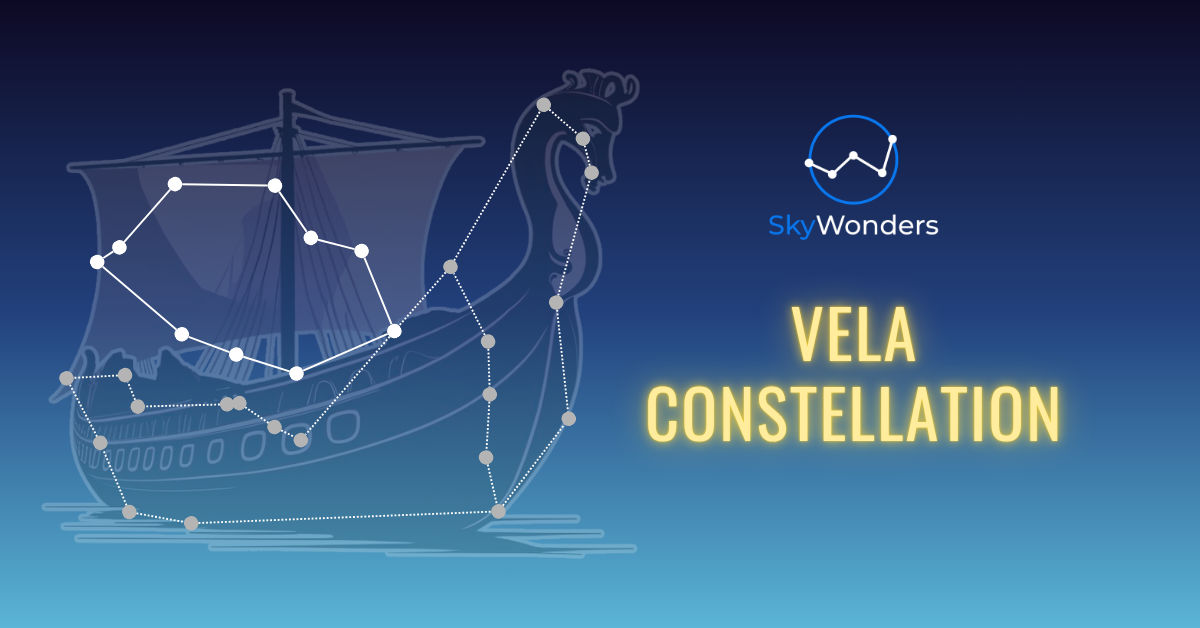
Vela, whose name means “the Sails” in Latin, is a constellation located in the southern sky. It represents the sails of Argo Navis, the legendary ship that carried Jason and the Argonauts on their quest for the Golden Fleece in Greek mythology.
Vela is notable for Gamma Velorum, a multiple-star system containing an exceptionally hot and luminous Wolf–Rayet star. The constellation also features several remarkable deep-sky objects, including the Vela Supernova Remnant, the Pencil Nebula, and the open cluster IC 2391.
Overview
Vela lies in the southern sky, within a star-rich region of the Milky Way. It borders Antlia, Pyxis, Puppis, Carina, and Centaurus.
Covering approximately 500 square degrees, Vela ranks 32nd in area among the 88 modern constellations. It is best observed in the evening from January to April, with March and April offering particularly favorable viewing conditions. Vela appears relatively low above the horizon for observers in the Northern Hemisphere but is much easier to observe from the Southern Hemisphere.
Because it lies within a dense region of the Milky Way, Vela contains numerous open clusters, nebulae, and stellar remnants. This makes it an interesting region for observing with binoculars and telescopes.
Shape
Vela represents the sails of the ship Argo Navis. In the traditional depiction, it forms the sail section of the vessel, positioned between Carina, which represents the keel, and Puppis, which represents the stern.
The brightest stars in Vela are spread across an elongated region of the sky. Gamma Velorum, Delta Velorum, Lambda Velorum, and Kappa Velorum are among the prominent stars that help identify the constellation.
Some of Vela's stars also form part of the famous False Cross asterism, together with two stars from the neighboring constellation Carina.
Notable Stars
Gamma Velorum
Gamma Velorum is a remarkable multiple-star system located approximately 1,000 light-years from Earth. Its most prominent components include a massive Wolf-Rayet star and a hot blue O-type star, making it one of the most fascinating massive-star systems in the night sky. The Wolf-Rayet component produces powerful stellar winds and is in an advanced stage of stellar evolution.
Delta Velorum
Delta Velorum is a multiple-star system located approximately 80 light-years from Earth. Its brightest components form an eclipsing binary system, causing noticeable changes in the system's apparent brightness as the stars pass in front of each other. It is also known by the traditional name Alsephina.
Suhail
Suhail (Lambda Velorum) is an orange supergiant located approximately 570 light-years from Earth. It is a semiregular variable star whose brightness fluctuates over time due to changes in its outer layers. Its warm orange color makes it one of the distinctive stars in Vela.