

Gemini
The Twins
General Information
- Abbreviation: Gem
- Area: about 514 square degrees
- Area rank: 30 among the 88 modern constellations
Introduction
Gemini, also known as the Twins, is one of the most recognizable constellations in the night sky. It is identified by its two bright stars, Castor and Pollux, which represent the twin brothers in Greek mythology. Gemini is one of the 12 zodiac constellations and lies along the ecliptic, the apparent path of the Sun across the sky.
Besides its two famous stars, Gemini contains several notable celestial objects, including the open star cluster M35 and the planetary nebula NGC 2392, commonly known as the Eskimo Nebula. The constellation is also the apparent radiant of the famous Geminid meteor shower, which occurs every December.
Overview
Gemini lies near the constellations Taurus, Auriga, Lynx, Cancer, Canis Minor, Monoceros, and Orion. Covering approximately 514 square degrees, it ranks 30th in size among the 88 modern constellations.
The constellation is best observed from December to April, with January to March offering particularly favorable viewing conditions. During this period, Gemini appears relatively high in the evening sky, making it easier to observe.
One convenient way to locate Gemini is to start with Orion. From Rigel, imagine extending a line through Orion’s Belt in the direction of Betelgeuse. This extended line leads toward the region containing Castor and Pollux, the two bright stars marking the heads of the twins.
Gemini also lies along the ecliptic, so the Sun, Moon, and some planets can appear to pass through the constellation as they move across the sky.
Shape
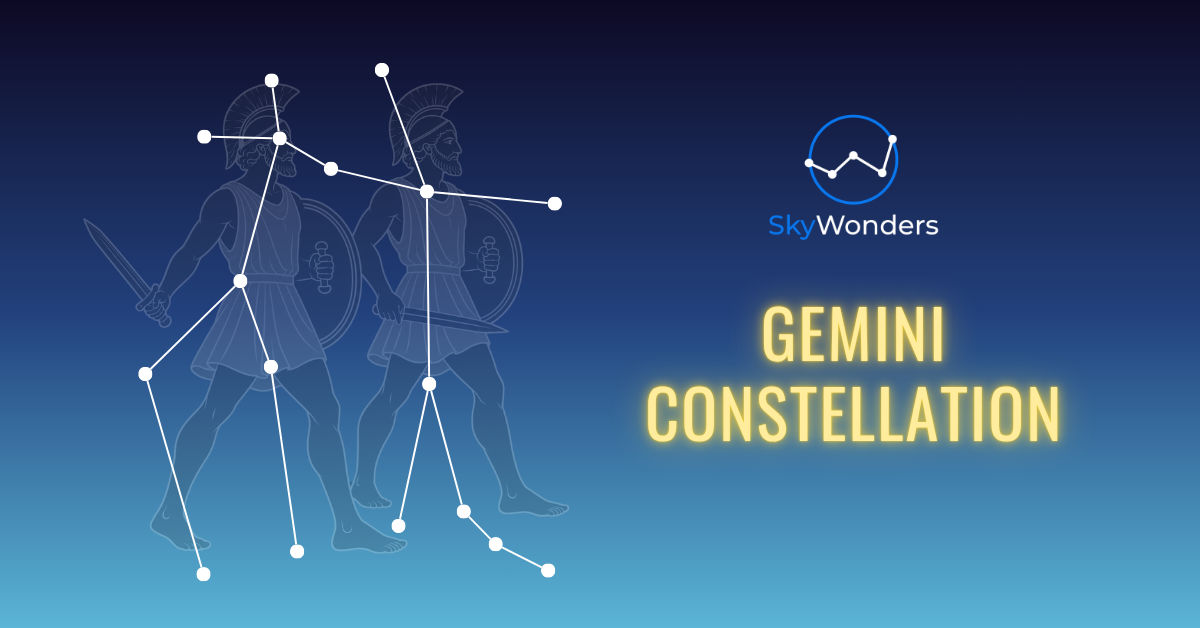
Gemini is traditionally depicted as two brothers standing side by side. The bright stars Castor and Pollux mark the heads of the two figures, while other stars extend downward to form their parallel bodies.
Pollux lies southeast of Castor and is slightly brighter. From these two stars, relatively straight lines of stars extend downward, with Alhena marking the foot of one of the figures.
Its fairly symmetrical shape and two closely positioned bright stars make Gemini one of the easier constellations to recognize in the night sky.
Notable Stars
Castor
Castor (Alpha Geminorum) is one of the brightest stars in Gemini, located approximately 51 light-years from Earth. It is a remarkable sextuple star system consisting of three pairs of stars gravitationally bound together. Its two brightest components can be distinguished with a small telescope.
Pollux
Pollux (Beta Geminorum) is the brightest star in Gemini, with an apparent magnitude of approximately 1.2. Located about 34 light-years from Earth, it is an orange giant that is significantly larger than the Sun. Pollux is also known to host an exoplanet named Pollux b, also called Thestias.
Alhena
Alhena (Gamma Geminorum) is a white subgiant star located approximately 109 light-years from Earth. It is the third-brightest star in Gemini and marks one of the feet of the celestial Twins. Its name comes from Arabic and refers to a mark on the neck or brand of a camel.